
BEST PRACTICE RIPARIAN PLANTING - MANGAMAHAKI
SUMMARY
The Mangamahaki Catchment Group, supported by a TLC grant and additional funding from the Cyclone Gabrielle Appeal Trust, is showcasing best practice for establishing and maintaining riparian planting following willow removal from the Mangamahaki Stream by Hawke’s Bay Regional Council.
The ambitious project saw 3300 plants and trees planted along a stretch of the Mangamahaki Stream adjacent to the Omakere Hall.


BACKGROUND
The community’s concerns about the state of the Mangamahaki Stream, its significant flood risk, and its impact on businesses and the community were expressed at a meeting with HBRC in April 2022. It was agreed that a proactive approach was needed to prevent ongoing stream degradation from congestion caused by trees and residual debris, which were leading to significant sediment loss, impacting water quality and stream health, and increasing safety concerns.
In response, HBRC recently began a three-year willow removal project to clear trees and debris along the stream, from the Omakere Hall to its confluence with the Tukituki River, covering approximately 25.5 kilometres.
Waipukurau nursery, Central Natives, joined the project to help devise a planting plan tailored to the specific conditions of the area. At a site visit prior to the first planting day, TLC met with local farmers and the team from Central Natives to observe the floodwater levels. The group decided to limit the plant species to those that can tolerate being underwater during floods and allow debris to pass over or around them.
The Mangamahaki planting project aims to ‘rethink riparian planting’ by showcasing best practices for establishing and maintaining riparian planting after the removal of willows. Through investigation and trialing of the latest approaches to riparian planting, TLC has gathered information to share with other sub-catchments.
PLANTING PLAN
Thank you to Central Natives for devising this planting plan.


COMMUNITY PLANTING IN ACTION
At the first community planting day in June 2024, the Omakere community came together for an impressive endeavour, planting a thick mat of Carex Secta on the bends exposed to the full impact of floodwaters. These grasses have a robust root system that helps hold banks together and can handle water flowing over them without damaging the plants.
A number of donated Western Himalayan Alder trees were also planted as part of a trial to test how this variety work in the riparian environment.
At the end of June, heavy rain raised the level of the Mangamahaki Stream, submerging the 1,300 new grasses planted just a few weeks earlier. For a few days, many of these grasses were underwater but the carefully selected grasses survived the flooding.
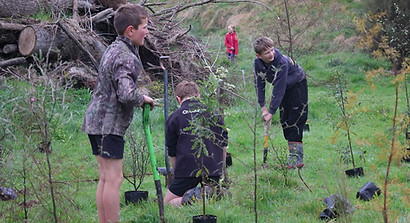
At a second planting in July 2024, 1000 native plants including flax, umbrella sedge, cabbage trees, ribbonwoods, manuka and toetoe were planted by local volunteers. Most of the non-grasses have been staked to improve survival, with ongoing care planned to ensure their success. Subsequent planting days by students from Omakere School also took place including one in September 2024 which was supported by players from the Hawke's Bay Magpies rugby team.
In August 2025, year 8 students from Omakere School helped get some replacement plants in the ground. These plants were generously funded through the Cyclone Relief Fund.
In a few years, this area will be transformed into a vibrant natural space, a true asset to the Omakere community. Thanks to the generosity of Joseph and Jeanie Butler, who plan to provide public access, all the community will soon have the opportunity to enjoy this remarkable restoration.



WITH THANKS
-
The Mangamahaki Catchment Group
-
The Butler family
-
Central Natives
-
HBRC
-
The Omakere Community
-
Omakere School
-
Cyclone Relief fund, via the Hawke's Bay Foundation'
-
Hawke's Bay Magpies

FURTHER INFORMATION & CONTACT
To find out more about the the Mangamahaki sub-catchment, head to the Mangamahaki sub-catchment page on this site.
To get in touch, please contact TLC Catchment Coordinator Pixie Seligman:
Email: tukicoordinator@gmail.com
Phone: 027 721 2423