
MAKARA CATCHMENT
Primary township Elsthorpe
Area 12,465ha
Land use: 91 percent of the catchment is in pasture, six percent in exotic forest and two percent indigenous forest.
CATCHMENT
GROUP
Committee members Andrew Thomas, Kate Laugesen, Tim Forde, Ray Munn, Richard Scott
Co-Chairs Andrew Thomas and Kate Laugesen
Catchment Co-ordinator Pixie Seligman
Email tukicoordinator@gmail.com
Phone 0277212423


ABOUT OUR CATCHMENT
TLC DEMONSTRATION PROJECT - CATCHMENT STOCKTAKE & WATER MONITORING
In 2023, TLC awarded a Demonstration Grant to the Makara Catchment Group to undertake a whole-of-catchment assessment aimed at recognising progress to date and identifying priorities for future action. 25 landowners took part in the study, representing a combined area of 14,806 hectares across the sub-catchment.
1. State of the Nation Report
A final report produced by agricultural consultants KS Agri offers valuable insights into environmental challenges and opportunities in this sub-catchment, gleaned from farmer interviews, analysis of Farm Environmental Management Plans, and mapping.
One of the key outcomes was the establishment of a water quality monitoring programme at four sites across the sub-catchment.
2. Water Testing Programme
In September 2024, TLC agreed to commence a 12 month water monitoring programme at four sites in the Makara sub-catchment as recommended in the KS Agri Report. See water testing results below.


WATER MONITORING
In 2024, TLC engaged KS Agri to complete a catchment stocktake for the Makara sub-catchment. Following recommendations from the report, local landowners used a TLC grant to begin a water testing programme at four sites within the catchment.
Between August 2024 and August 2025, TLC supported the Makara Catchment Group with monthly water testing at these sites. The testing was carried out by ALS Environmental and the summary report was produced by Water Sense Te Wai Tikanga.
TLC Makara Sub-Catchment Water Testing Summary Report


MAKARA
COLLECTIVE FOOTPRINT
As at March 2024:
8,767 erosion poles planted since 2018
63ha of wetlands fenced over 8 farms
54.5km of riparian fencing completed
0.5% (97ha) of the catchment is in QEII
110ha of native bush and regenerating Manuka
THE BIG PICTURE
The Big Picture
As part of The Big Picture project, TLC has developed independent, science-backed catchment plans for each of the 17 sub-catchments of the Tukituki River. These farmer-led plans address key environmental challenges specific to each area while identifying practical, affordable solutions. These plans do not impose rules or regulations but they give farmers and catchment groups a roadmap for future planning to improve water quality, boost farm productivity, and open the door to future funding opportunities.
TLC partnered with environmental planning consultancy Environment, Innovation and Strategy Ltd (EIS), who collected data specific to each sub-catchment, including erosion maps, flow path models, land use capability, soil types, and water monitoring information. Alongside the scientific data, in December 2024, TLC hosted workshops for farmers and growers in each sub-catchment to make sure the solutions aligned with the realities of farming and growing in each sub-catchment.
Makara Draft Sub-Catchment Plan: Summary
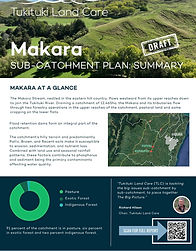
Makara Draft Sub-Catchment Plan: Full Report

Makara Catchment Maps

TLC FARMER TOOLBOX
Tools for the Makara Catchment
As part of The Big Picture, TLC has developed the TLC Farmer Toolbox, designed to support landowners in making informed decisions and enable them to implement changes with confidence, ensuring that time and money are invested wisely.
The TLC Toolbox includes the following:
-
TLC’s On-Farm Action Planning Tool - prioritise on-farm environmental actions based on their cost-effectiveness and impact.
-
TLC’s Plant Selection Tool - choose the right plants for on-farm environmental projects by matching your planting zone and purpose with suitable species.
-
TLC’s Surface Erosion Tool - determine the most erosion-prone areas on your farm to identify priority sites for effective soil conservation measures.
-
TLC’s Water Runoff Mapping Tool - identify sites for on-farm edge-of-field mitigations such as sediment traps, constructed wetlands and detention bunds.
-
TLC’s Riparian Mapping Tool - better understand riparian condition and vegetation class along waterways to prioritise where riparian management should occur.
-
TLC’s ETS Guide- download TLC’s ETS Guide for key information on the Emissions Trading Scheme, including its purpose, benefits, eligibility, enrolment process, and potential costs and returns.
-
TLC’s Willow Management Guide - download TLC’s Invasive Willow Management Guide for insights on willows in the Tukituki, control strategies and riparian restoration.
-
TLC’s List Of Advisors - connect with local advisors for tailored advice and potential funding opportunities.


